

How Does A Build Array With A Shift Register And An Initialized Array Work Labview
trouble with the shift annals
for purposes of simplicity, I remove code without bug
Description:
1. my country machines, for some reason, a lot of cases.
2. the lodge of each case may not modify.
iii. the primary prupose is to get the difference every bit on the front panel
4. prior to entry divergence, I showtime is measured in the case where 2 and Try using shift register to pass data, ideally at least five
5. However, the "previous" value is updated besides soon, unlike 'get' is ever ZERO.
for case
You can meet the shift register on the left side has two components, ideally, the 'go' departure should display ii-0 = 2.
However, given that the second element of the registry team updates as well early, my objective cannot attain and see upward with ALWAYS 0
I think it's my misuse of the shift register for the computer to several cases.
I pasted this trouble for 4 hours... kind of stupid, but could not understand
in a mulit-case state machine, how to properly passes data to the example (v in this example) Instruction to ensure that I get the correct adding
GOLD: because I am only looking to the electric current value and the previous value, are there other ways to become this problem is?
Give thanks you lot
It is a example where execution highlighting tin be helpful. Plow on execution highlighting past clicking the light bulb on the cake diagram toolbar. So, run the Half-dozen. You will see the left side of the team to register the change as the country machine goes through States 3 and 4. At the time where what happens to v, all data in the modify record is identical.
One of them might exist to utilize two registers to first, ane for the current value and the other for the previous value.
Lynn
Initial value shift annals
I wrote a simple plan with a while loop that contains a shift register that tape the value of the previous iteration. When I stop the plan and restart the plan fifty-fifty once, I thougth the shift register value will reset to 0 (for a type of information I32)? Apparenetly, the shift register keeps the value of the previous run until I stop the program. Why is this? Why change doesn't register reset?
Trouble fill-in a table using a shift register
In the attached 6 I'm build a table one d of channels, and so try to record using a shift register. For some reason any is not backed up my data and I don't understand why.
Thank you.
Y'all must connect the table where all empty, else it will reset to an empty array whenever such a case occurs.
You besides need a registry change on the inner loop.
How to make shift annals init happens simply once, so that the data can persist beyond multiple tracks of a loop?
Here's the situation:
Nosotros are repeatedly followed eight existent-globe signals and comparing them to a threshold value. We practise this via a loop For within a While loop. The loop For runs 8 times per pass. We have implemented a binary table ane d and the use of the alphabetize of the loop For as the array alphabetize, by putting a Boolean result in the tabular array using the role replace tabular array subset. We want to go on the information in the table to be 'viscous', in the sense that any Truthful value is locked, so even if a fake comes subsequently, this array chemical element true. However, since nosotros initialize the array in order for the replacement to the work table, we encounter that whenever the loop For again, it resets the table and destroys the history.
I have fastened a simple Half-dozen to illustrate the concept, using a random number generator as a stand-in for the existent world signals. How we modify this Half-dozen exercise and entered existent lock through multiples for loop runs, indefinitely?
In example it is not obvious, I am a relative beginner, so delight proceed count in your response.
Thank y'all
B
scottbbb wrote:
For B, although I love the simplicity of it, I accept a question: it solves the problem of the re-initialization? What the shift of the While loop register become initialized - merely in one case during its launch?
Yep, the shift register Initializes just at the beginning. You could say that every fourth dimension the while loop is called (not each iteration) the shift register is reset with the wrong table.
And, Yes, GOLD will ever keep a Existent when it is TRUE.
Usually, the simplest solution is the all-time.
Shop the Teststand ActiveX reference in the LV shift register
It is posted here
I'm trying to store the references TestStand ActiveX in a shift register not initialized a Vi. In my case, the references are passed into the TestStand Vi (non created from in VI). If I call the aforementioned VI to the next step (same sequence and execution of the previous step), since the shift register ActiveX references are non valid.
The Six remains reserved to run during these 2 stages and is non unloaded from retention, and then the shift register data should remain intact (in fact, the numerical values of the references are actually kept). LabVIEW is still trying to close any ActiveX reference, even if they were not created from the VI? Is there a fashion effectually this trouble? Or I'm just something incorrect?

jsiegel-
In general, when the code is passed a COM reference and code is to keep the reference to a global or shift register, fifty-fifty after his return from the call, the code must add together a reference to the object so that the object server knows that the object must be destroyed not. Information technology is also the responsibleness of the code that fits on the reference in the world or a register shift to release the reference to the object when it is no longer necessary. LabVIEW is non different from whatever other linguistic communication.
Then, here are more details. TestStand application LabVIEW for run the VI, TestStand after the reference as a parameter to the method of the server to run the LabVIEW VI. COM creates a proxy for reference and give the reference of proxy for the code module. Your VI then stores the value of the proxy reference in the global or the shift register. When your VI ends and returns to TestStand, COM releases the proxy reference, the value in the global or the shift register is no longer valid.
Basically, yous demand to add or duplicate the reference to the object passed in LabVIEW by calling the VariantToData function. Pass the existing reference, set up the input type to the same type of the reference, and the issue will be the reference in doubles. You tin can assign the double reference to worldwide or register.
Normally you lot must well to release the reference later past reading the value of the global or shift annals, explicitly calling the function shut reference with which to reference, then assign A Refnum Abiding stepped upwards to the global level or shift annals to nullity. In the case of a module of code, I believe that when TestStand unloads the 6, LabVIEW frees the reference correctly. If this isn't the case, y'all will become a debug message to unpublished during the TestStand stop object if you lot have this pick enabled.
How to programme the shift annals to play but when a new user is detected user?
How-do-you-do
I'm currently developing a program of position control in labview. The program is quite simple, in which case the user will enter the distance on which he wants the tabular array in the labview program and labview will send the signal to move a motor that volition plow a ball screw to move a table horizontally to the targeted position. The criterion is that the contour of the engine depends on the distance to move, if a biphase (acceleration and deceleration) or three phase (acceleration, steady speed, deceleration) to reach the position of the target.
The trouble occurs when the user wants to enter a new entry second position) for the tabular array, equally the input by the user is the position that the table should be, but the necessary input to make up one's mind what profile the engine follows depends on the distance that the table moves to the target position. Therefore, I need a role to save the entry past the user temporarily and reminds that when a new user input is detected. Hereby, I would be able to use the difference of the input (input [n + 1] [n] input) and animal feed to determine what contour the engine follows and the entry by the user can exist kept in the position he wants to the table to get (to compare with encoder).
I thought to use for shift registers do, simply I am not able to perform the deduction ([n + 1] - [n]) but when it detects a new entry. When I try to utilise registry to offset, information technology moves to the target location, and we only reached information technology will become to the original position. For example, when a user entry 90, this means that the table must be moved to the betoken ninety. The shift register is initialized to 0, information technology will move to the point ninety (ninety-0 = 90), but arriving at 90, the shift register sends a signal of 90 (90-90 = 0) and the table back to its original position.
Is it possible that I can delay the reading of the shift register only when a new entry is detected or there at - it another style for me to achieve what I want?
I tried searching the forum site and neither discussion simply could not find similar problems. Thank yous for your aid in advance.
As I understand it, the use of shift registers with a construction of the event (to notice a user event when the user enters a new value) should solve the problem. Practice not forget to post your request (or a version of it that isolates the outcome) when you arrive at the lab, if we can become a articulate visual of the outcome you are facing.
Modify the shift register
I hope someone tin can directly me on that. I'm stuck.
The NTC, I want that it outset at zero, enter the nested loop
and when the case statement is equal to one, add together 3000,
so I have a lag on "undesirable" elements in the one d
table I'm parsing...
TIA!
the nested loop shift register is non initialized, it is best to initialize it with a constant 0
So, the index entry Array subset office is connected after or before the function incriment? I tin't decide...
in whatever case, if information technology is connected earlier the incremint function then the nested loop iteration 1 volition send a 0 at the entrance to the part of the subset of the Array index.
EWW! , a lot of entries, words of functions in the above paragraph lol  , can u get me hither?
now I tin can just empathize the problem what exactly you're talking nearly. the sequence of events for your code will exist like this:
Later on the nested loop is consummate, the output will be bachelor (1 d the function add array chemical element table) to the structure of the case where you want to add together 3000 to the value of the shift annals and start the loop nested with initialized once again records with value = 3000? Am I wrong?
If I'thou right, you must reset the shift by using a control register, create a local variable to him and place it in the business concern construction then her manipulate it as shown beneath:

Since the default data of "N" blazon digital command value is 0, so initially the shift registers will be initialized with 0 every bit the guy above
Thank you
Shift annals clear before rerunning the Six
I take this Half dozen very uncomplicated read the voltage of an acquisition of information until I stop the loop, and so it saves the data to a .wav file.
My trouble is: whenever I stop the Half dozen, I expect the registry to shift to clear. But if I restart the Vi it saves the old data in the shift register and the new data in the .wav file. I want to just the new data when I run the .Six, without having to close the programme each fourth dimension.
Help, delight.
Right-click on the control to the table, and cull "clear picture" (or any option os tht chosen) and try once more. It's a cluster of an array of types of waveform data. (Afterward), you tin right-click and choose "display as icon".
Ben
Table of shift register
I need to create a programme that takes an array of six elements and the use of shift registers if he pulled out a tabular array that maintains the first element of the same affair, and so adds the 2nd and third elements together, and so adds the second to the 6 ° element. So if the input array is 2, 12, x, 5, xx and 25, the output assortment is 2, 22 and 72. I call up that using shift registers and a loop would work, but I can't brand it piece of work.
Thank you for any help
Ok. Given that information technology is for a grade, I will do more than any code.
Comments.
ane. a shift annals is a local retentivity course. So, inquire yourself what this problem needs to exist recalled?
2. entry and exit tables are dissimilar sizes. No sense to wire the table via the shift register because the shift register will 'recall' how the input array is large.
3. Reflection on annotate one, how you will go the information in the tabular array to put information technology in the register shift?
4. what happens if employ you the same rules simply immune the input assortment having a size greater than or equal to 6? That's what is meant past an evolutionary approach to a problem. The code I posted works for length 6. For whatsoever other length program must be changed. A scalable program work without modification for any input of size.
It is ofttimes very useful to begin with a series of conditions, which you lot said we at present articulate. Then programme how you would the trouble with pencil and paper. Then implement this programme in the software.
Lynn
Shift register do not add
Hi all
I am trying to apply the shift register adding all the waveform detected. The additional upshot will be divided the electric current number of waveform to the average score. However, it seems that the shift annals does non at all. See the prototype beneath, if the waveform number is chiliad, the intensity of the signal averaging is of only i/1000 of the indicate detected. Theoreically, if no noise present and the shift register has added each detection, the average signal should exist identical to the detected signal. Can someone help me solve this problem?
Thank you very much
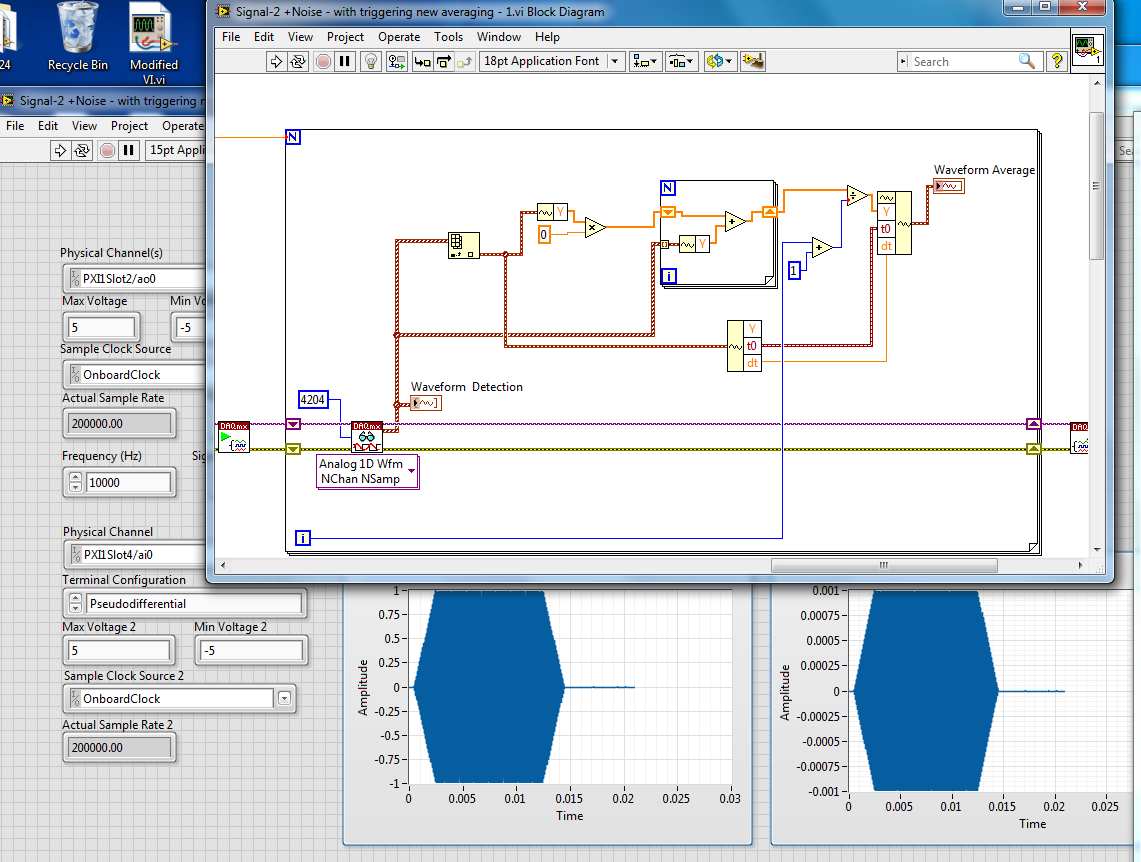
Showtime of all you should exist dividing by the end of the inner loop, I not + 1 of the outer loop.
If you want an average on the outer loop as well, you lot need a registry change in this loop.
Lynn
Table/Shift annals losing values
Howdy
I have attached the VI.
The 6 has a table with values in them. But, it looks a number when this number of games, it moves on a column and add everything in that cell in a table. He continues to do this until he sees 'END' at which point she stops.
The problem I accept is that everything seems fine for the start two "values" after which no thing what boosted value he caused he loses everything and keeps only the concluding known value.
Your current code takes the unique element of your table and makes a moving picture out of it. You lot then insert the name Test. So everything that precedes the family unit name went at that time.
Here is the code updated the minimum which keeps the Tabular array in the shift register and simply adds new examination name in the table.
Shift register
How-do-you-do all
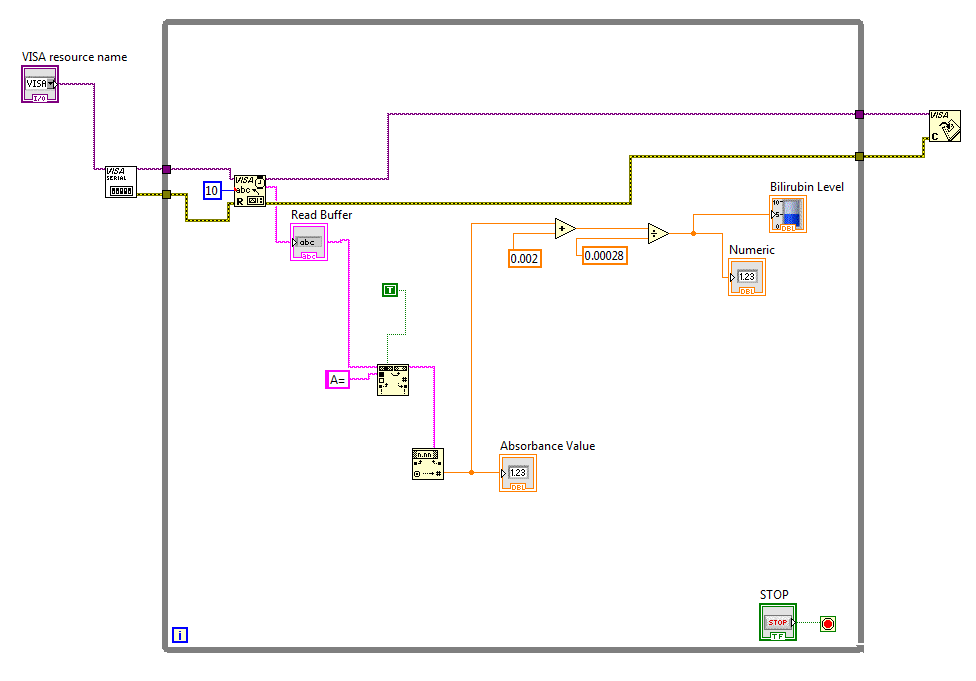
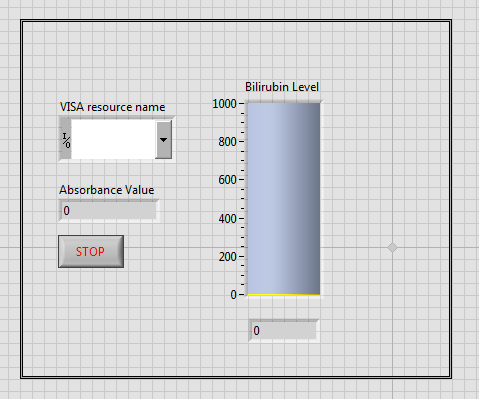
This is my block diagram and front end looks similar.the given, I received are spectrophotometer UV, using RS232. FYI, there is no error with the spectrophotometer pattern.readings cannot be read by LabVIEW.the problem at present is that reading spectrophotometer read but read to a time.here is the principle of performance of the spectrophotometer.note IM using spectrophotometer to measure the absorbance of the chemic solution.
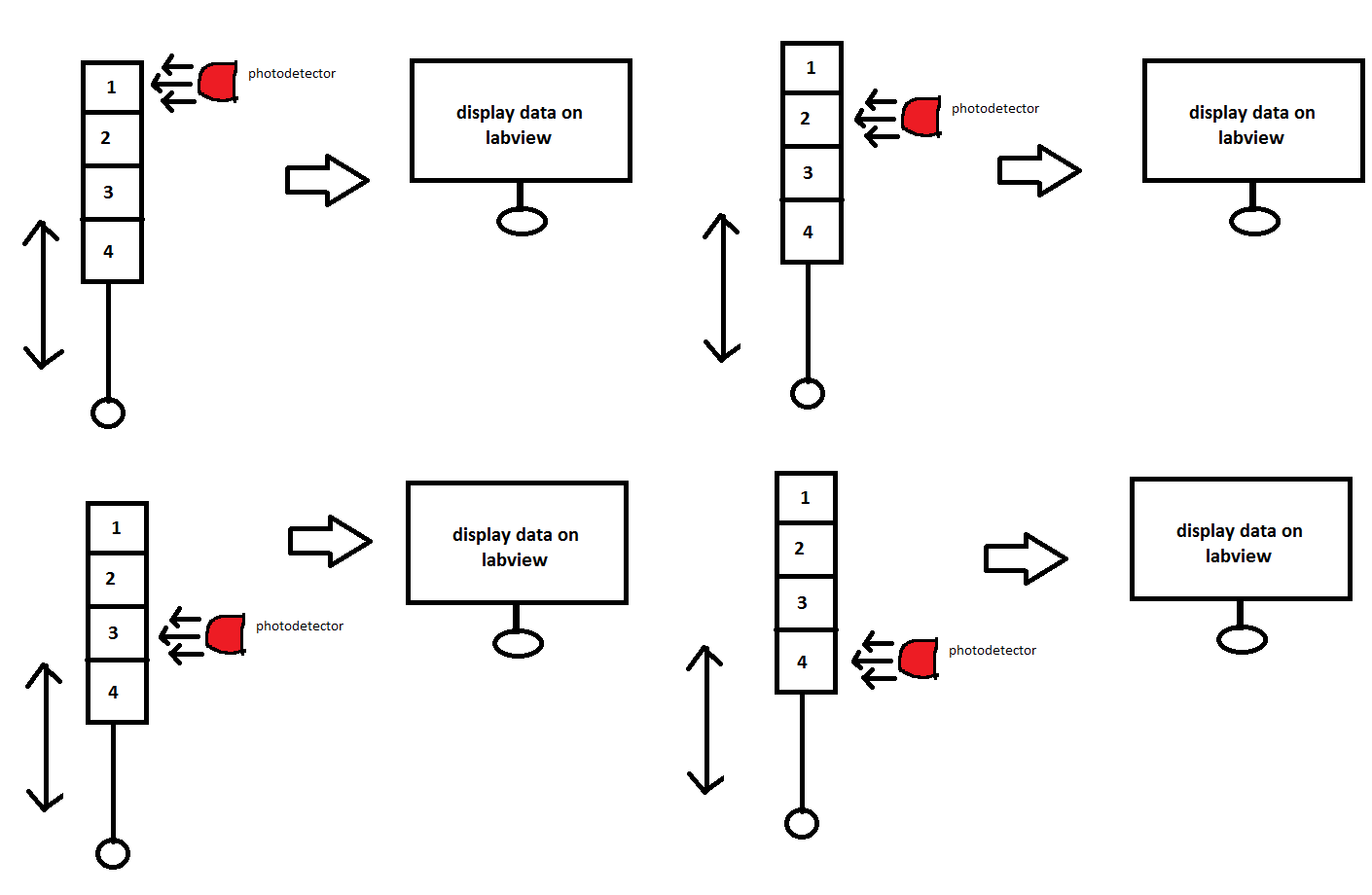
every bit u go push support for the sample on the position 1 to four, the information will appear on labview.the 1-4 sample solution is different.so, I want to show all the data at in one case for comparison. such as display them on the Microsoft graph nautical chart and information volition be saved on im always new excel.since with labview, I have no idea how am I supposed to do.
or maybe you have an thought or suggestion?
as an attachment, I besides tried shift annals, but the consequence will display the aforementioned value on all the indicators.how should I do to read the data and display them i by hateful of one.which in position 1, after the displayed result stop us the procedure, then switch to position 2 and visualize the data.and it continue until position 4 at the end show us all the data in a graph or chart.
your aid is greatly appreciated
If you use the manual sample positioning yous can accept one of the solutions, we have provided and add together the following.
Place the code we have provided inside (flat or stacked) sequence and add a frame before information technology. In this new context, add a while loop that has a button connected to the termination of the Last. Essentially, the lawmaking will sit down and expect until you press the push to have the measurement. (You tin add together a timer wait small to reduce the use of CPU, let's say 50 or 100 ms).
Note that this is a very raw solution as long as the treatment is inside this loop until the button is pressed. This prevents whatsoever other code to run. The event structures are more than robust.
If you desire to automate this process, a motorized linear actuator would piece of work well (although probably not worth it for 4 measures).
Shift register practise non reset
Tin can someone take a look at this .half-dozen and tell me why the shift register is non set to zero. It's a program that I am tempted to write to find areas of leading-edge information in a psd.
Thank you
Pupil researcher
NVM. found the trouble. my time was incorrrect loop status.
Reset the shift register according to value
Hey in that location ' All, I've been thrown in Labview to piece of work, so I made a few minis and other programs on my own. The last one I wrote is a system of notification by e-mail, because it'southward something I plan use a lot. The idea is, I accept a random number generator that collects a number every 100ms using a timed loop. When a number is greater than a certain threshold, say 0.five, an email is sent and a flag is hoisted. From there on, I don't want to ship any other emails until the number is BELOW a sure level, say, 0.3. With what I wrote, I get emails to ship no problem and I tin can't stop them sending (using a combination of Boolean indicator and a shift register), but I tin't understand how to to reset the indicator to allow emails as presently as I "ringlet" a number under my lower threshold.
Is in that location a fashion I tin reach this? I would exist deeply obliged for any aid. I take fastened the VI I did below, apologies, if information technology is messy and so on.
Use a Select statement after the structure of the example. If the reset condition is True, so thread a real abiding through the register shift. If the reset status is Faux, then just wire the existing through the annals shift.

How Does A Build Array With A Shift Register And An Initialized Array Work Labview,
Source: https://www.eehelp.com/question/problem-initializing-shift-register/
Posted by: mccullochwhatiall.blogspot.com
0 Response to "How Does A Build Array With A Shift Register And An Initialized Array Work Labview"
Post a Comment